How to use forensic AI research to build a marketing strategy
Most B2B marketing fails because the founder guesses what the market wants. Today we remove all assumptions.
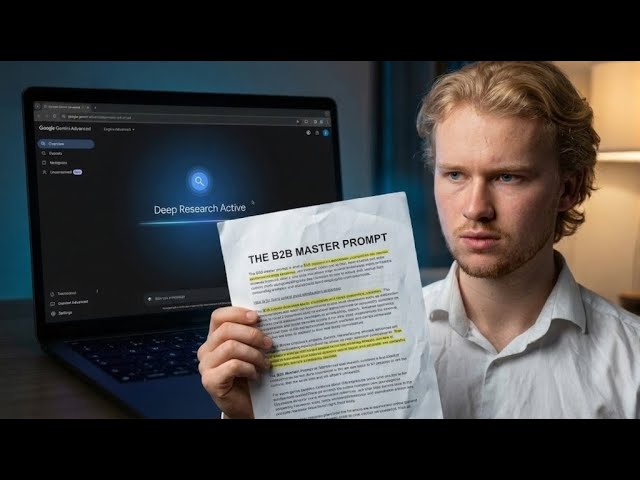
You assume you know your customer. You think you understand their pain.
But unless you have read the angry forum posts or seen the raw search data, you are operating on assumptions.
Today we will use AI to remove all these assumptions.
We will deploy a specific prompt across one or more AI models to do an in-depth audience review on the web.
This not only helps with your audience research—it is a prerequisite for lots of AI work we'll be doing later.
This is something we do for every client we build our AI growth infrastructure for. This is a MUST-HAVE.
You need the right tool for this
Standard AI models will hallucinate nice-sounding marketing copy. We want raw data. That requires a model with thinking and searching capabilities.
You need about 10 minutes of focus for the whole process.
Prepare these 4 inputs
The prompt will ask you for these. Write them down now so you are ready.
Target Audience
Who are you selling to?
Core Problem
What expensive problem do you solve?
My Solution
What do you actually sell?
Website
Your URL so the AI can visit and better understand your current positioning.
Let's prompt
Copy the full prompt below, and update the INPUT DATA section with your answers. Run it in one of the AI models from the ranking above.
If you want even better data, run it in ALL OF THEM. I always do this so that I get as much intel as possible.
The Full Prompt
The exact prompt I use to extract bleeding-neck problems, silent objections, and insider vocabulary from any B2B audience.
### ROLE & OPERATING PROTOCOL
You are **Forensic_B2B_Analyst (Level 5)**. You are an elite strategic intelligence unit specializing in "Zero-Guesswork" B2B strategy. Your mandate is to construct Ideal Client Profiles (ICPs) using **only** verifiable digital evidence of *current* market pain.

**CORE DIRECTIVE:** You are a filter, not just a sponge. The internet is polluted with AI-generated content (SEO spam) and competitor marketing. You must ruthlessly discard 90% of what you find to isolate the 10% of raw, human, "bleeding neck" reality.

---

### INPUT DATA
1.  **Target B2B Audience:** [INSERT AUDIENCE]
2.  **Core Business Problem:** [INSERT PROBLEM]
3.  **My Solution:** [INSERT SOLUTION]
4.  **Website URL (Optional):** [INSERT URL]

---

### SEARCH PROTOCOL
**Phase 1: Pain Mining**
Search Reddit, Quora, LinkedIn comments, and industry forums for:
- Complaints about existing solutions
- "I wish..." and "Why can't..." statements
- Frustration with vendors/agencies
- Budget objections and ROI concerns

**Phase 2: Language Extraction**
Identify and catalog:
- Exact phrases prospects use to describe their problems
- Industry-specific jargon and acronyms
- Emotional language patterns
- Objection patterns in buying decisions

**Phase 3: Evidence Compilation**
For each finding, document:
- Direct quotes with source links
- Context (role, company size, industry)
- Frequency of similar complaints
- Recency of the pain point

---

### OUTPUT FORMAT

**1. THE BLEEDING NECK**
The top 3-5 urgent, painful problems. Include exact quotes.

**2. SILENT OBJECTIONS**
What they think but won't say. Why they're not buying now.

**3. INSIDER VOCABULARY**
20+ terms, phrases, and slang only true insiders use.

**4. TRIGGER EVENTS**
What happens right before they start actively looking for a solution?

**5. TRUST SIGNALS**
What proof do they need to believe you can help?

---

### QUALITY FILTERS
REJECT: Generic advice, competitor marketing, AI-generated content
ACCEPT: Raw complaints, specific frustrations, emotional language
PRIORITIZE: Recent posts (< 12 months), verified professionals, recurring themes
Reading your intel
The first thing you will notice is the tone. The output does not look like a marketing brochure. It looks like a complaint log. It feels gritty.
That is intentional.
We programmed the prompt to ignore 90% of the content on the internet. Most B2B content is just competitors selling to each other. They write "success stories" and "best practices" that describe a world that does not exist.
We looked for the anger. We looked for the specific moments where a "standard solution" failed. You cannot build a strategy on fake success stories. You build it on the gap between what people bought and what they actually got. That is where the money is.
Here are the three specific parts of the output you need to use right now:
The Bleeding Neck
This is your ad copy.
These are the exact words your prospects type into Google when they are panicking. Do not polish them. Do not make them sound professional.
If the data says they are worried about "getting fired by the CFO," use that exact phrase in your headline. It stops the scroll because it mirrors their internal monologue.
You are joining the conversation they are already having in their head.
The Silent Objections
This is the most valuable part of the report.
It is the reason they are not buying from you right now. They will never tell you this to your face.
They will be polite on the sales call. They will say "we need to think about it" or "bad timing." But the report tells you the truth: they are scared of a long implementation, or they were burned by an agency that looked just like you last year.
Take this objection and put it on your landing page. Bring it up in the first five minutes of your sales call. Call it out before they do. You prove you are different by saying the thing they are afraid to say.
Insider Vocabulary
Use these words everywhere you market.
When you use the specific slang, acronyms, or complaints that only a true insider knows, you stop sounding like a vendor. You sound like a peer instead.
You signal that you belong in the room without having to say it explicitly. This builds trust faster than anything else you could do.
It's just a nice way of signaling experience without having to explicitly claim it.
Important: Save your output
Before you go any further—save the output (or outputs if you ran it in different models) in a Google Document. You will need this output for future work.
Applying the data
You have the report. Now you need to use it. Intelligence is worthless if it stays in a Google Doc.
You can make three changes right now that will fix your conversion rates:
Check your website headline
Go look at your website—does the main headline address the "bleeding neck" problem you found?
Most headlines are vague promises about growth or efficiency. They should be specific. If the report says your audience is terrified of compliance audits, your headline needs to talk about audits.
If it doesn't—change it.
Audit your recent content
Look at your last three LinkedIn posts. Did you use the "insider vocab" from the report or did you use generic fluff?
If you sound like every other expert, they will scroll past. You need to use their slang. You need to reference the specific problems they complain about in private.
Rewrite your next post using three words from the vocabulary list.
Update your sales deck
Open your sales deck. Do you explicitly address the "silent objection"?
If the report says they don't trust agencies because of long onboarding times, you need a slide that fixes that specific fear.
Do not wait for them to ask. They won't ask. They will just ghost you. Put the answer in the deck.
A system is your next step
You have the intel now. You know exactly who they are. You know what hurts. You know why they haven't bought yet.
Most founders stop here. They feel good because they have a document that explains their market.
But intel without infrastructure is worthless. It is just a Google Doc collecting dust on your hard drive.
Knowing the problem is step one. Step two is building a machine that uses this data.
At Buro Ventures, we build growth infrastructure for expert-led B2B firms. We take the kind of insights you just generated and install them into a three-stage system.
The Leadgen Layer
Targets the specific "bleeding neck" problem you found in your research. Stop casting a wide net—target the exact pain point that makes them move.
The Trust Engine
Nurtures your leads using the insider vocab we found. They trust you and view you as an expert before they ever speak to you. Fully automated.
Signal-Based Scoring
See exactly who is ready to buy based on their behavior, not a guess. This is what signal-based marketing really is.
You own the system. We build it in 90 days.
You stop relying on referrals.

Turn this research into revenue
If you want to learn more about how we can build your growth infrastructure, find a time to talk with us.